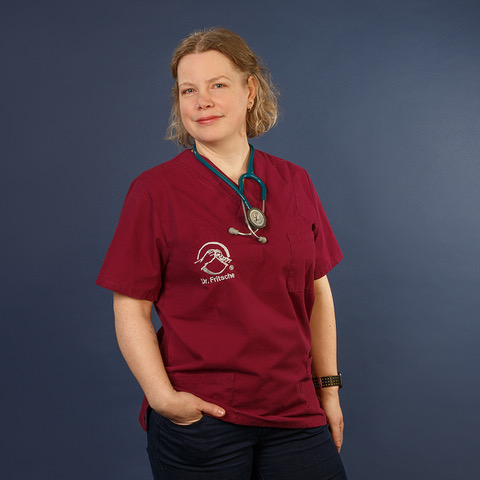
Veterinarian in Berlin, specialised in behavioural medicine — and a passionate dog owner for many years. Here you'll find my path into the field and the approach I bring to my work.
My path
From the lab and small-animal practice into behavioural medicine.
I completed my veterinary studies in Berlin and passed the state examination in 2008. Alongside my doctorate on equine herpesvirus, I worked as a junior vet in a small-animal practice on Berlin's outskirts — including emergency and weekend shifts. In that time I saw and treated a broad range of cases.
Three years later I moved to a small-animal practice in Brandenburg. In daily consultations I noticed that owners were increasingly raising not just physical but also psychological issues in their dogs and cats. That need, combined with my personal involvement in the field, reshaped my professional direction.
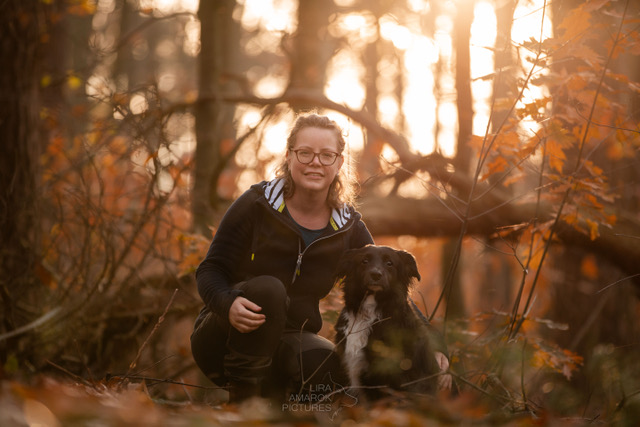
For many years I was active in the search-and-rescue dog unit of a large German aid organisation, together with my dog Wilma. There I learned how much expressive behaviour tells us — and how much can be achieved with good training. From that experience grew the wish to specialise in animal behavioural medicine. Between 2013 and 2014, I completed the eight modules of animal behaviour therapy at the Academy for Veterinary Continuing Education (ATF) in Hanover. Further continuing education has followed in the years since.
With Wilma in the forest — years of search-and-rescue dog work shaped how I read canine behaviour.
Today I'm glad I can bring my personal interest in animal behaviour together with my veterinary training — and use that combination to help you and your animal.
My philosophy
With the same respect I would show a person.
Animals — like people — have their own character, and they can learn. That's exactly why I meet them, as we work on un-learning and re-learning, with the same respect I'd extend to a human counterpart.
Look into your dog's eyes and try to say that animals have no soul.
Victor Hugo
For many people — myself included — animals are an important part of life. For that coexistence to work, the needs of both sides have to be taken seriously. As a veterinarian, I always keep possible physical causes of behavioural problems in mind and work closely with your regular vet. In behavioural therapy itself, I rely on positive reinforcement; in difficult cases, time-limited medication can be helpful.
Of course you can live without a dog. It's just not worth it.
Heinz Rühmann
A central element of my work is communication. We humans rely mostly on language; animals rely mostly on body language and subtle signals. In my consultations I analyse the problem behaviour and make clear where person and animal are talking past each other. Together we look for solutions, clarify where boundaries are needed, and agree on a treatment plan that fits your particular human-animal team.
Humanity can be roughly divided into two groups: cat lovers and those whom life has otherwise short-changed.
Francesco Petrarca (1304–1374)
Cookies & privacy
We use Google Analytics to understand how this site is used. Your data will not leave the EU without your consent.
Privacy policy